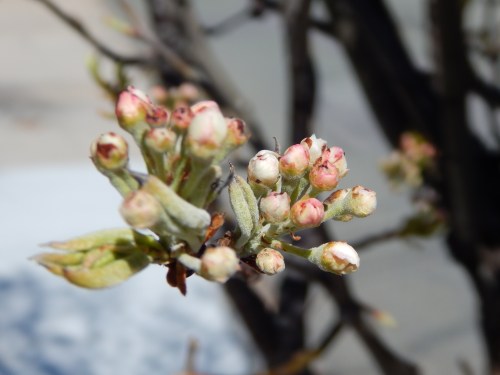
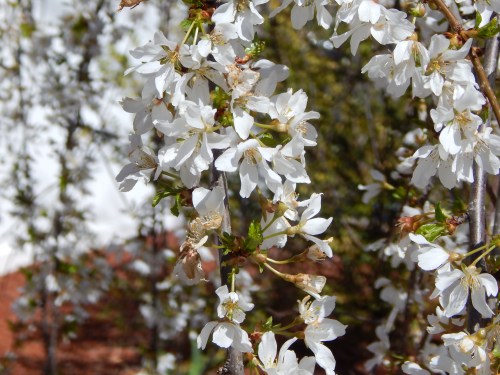
while walking the spring streets of Cambridge and Somerville
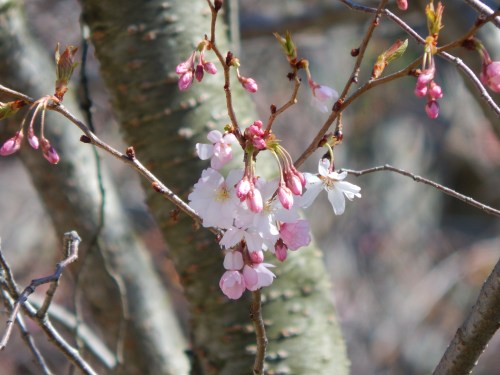
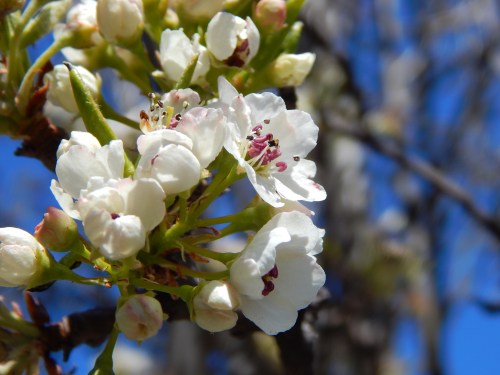
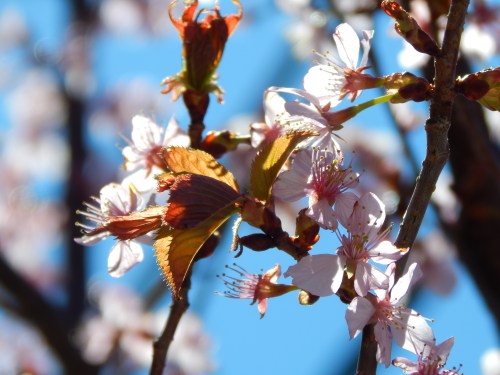
Posted in Branches, Inspiration, Nature Notes, On the Road, tagged beauty, colors, flowers, Inspiration, nature, Photography, urban landscape, walking on April 17, 2016| Leave a Comment »
Posted in Inspiration, tagged architecture, art, beauty, Boston, churches, Emmanuel Church, family, flowers, grief, history, Lindsey Chapel, Lucitania, Photography, stained glass windows, weddings on April 16, 2016| 4 Comments »
The church was decorated with Easter lilies and pink roses and the entrance to each pew marked by a cluster of lilies. Palms were placed in pew openings and stood at various points to create a natural chapel. Upon the altar more lilies and roses. The war had limited the number of guests in attendance but even so Emmanuel Church on April 21, 1915 was filled with those wishing well the bride and groom, Leslie Hawthorne Lindsey of Boston and Stewart Southam Mason of England.
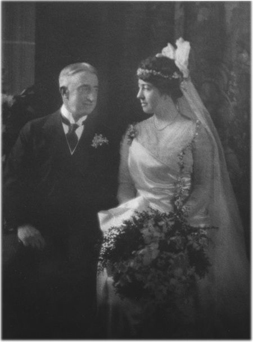
william lindsey, father of the bride, and daughter leslie lindsey
The bride wore white satin made with rose point lace and garnitures of small clusters of orange blossoms. The flowers held in place a veil of Limerick lace made especially for Miss Lindsey in Ireland the previous year. She carried a bouquet of white orchids and jasmine. Her wedding party wore shades of blue and pink silk, their gowns adorned by rosebuds. The bride maids carried baskets of pink sweet peas.
After the ceremony, there was a reception in the Bay State Road home of the bride’s father, William Lindsey. The bride’s mother now wore blue silk in a shade known as moonlight embroidered with baskets of silver. Flowers prevailed, decorating each room, smilax in the hallway, greenery entwining railings and baskets of roses on the stairs. Bells rung in celebration on both sides of the Atlantic as everyone knew that soon the bride and groom would return to his home in England and all they need do was board the Lusitania.
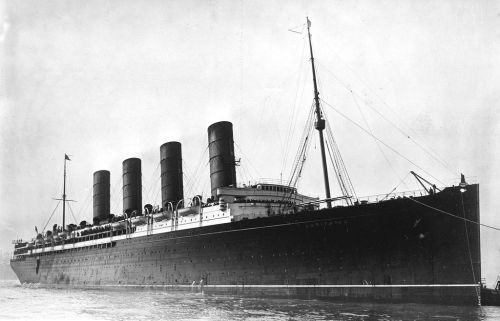
rms lusitania
The RMS Lusitania would depart New York for Liverpool on May 1, 1915. On May 7, it would be torpedoes and sunk by a German U-boat. At least 1, 198 passengers and crew would die, including newlyweds Leslie Lindsey and Stewart Mason. When the body of Leslie was returned to her father she wore the jewels that her father had given her.

A heartbroken father would do several things over the years in memory of his lovely daughter, one of which was to buy a piece of property adjacent to that of Emmanuel Church in 1919. A chapel would be built. Begun in 1920, the structure would be finished in 1924.

The chapel was designed by the architectural firm Allen & Collins. John Ninian Comper (1864-1960) designed the chapel’s decorative scheme from the altar to the chapel’s signature stained glass windows. Sadly, William Lindsey did not see the finished chapel. His youngest daughter shared memories of seeing her father sitting across the street watching the building’s construction and knowing he would not live to see it completed.
Sources and Further Reading
History of Lindsey Chapel on Emmanuel Church website
Boston Evening Transcript, April 21, 1915
Posted in Inspiration, tagged architecture, art, Back Bay, beauty, colors, faith, Inspiration, Photography, religion, stained glass, windows on April 14, 2016| 5 Comments »

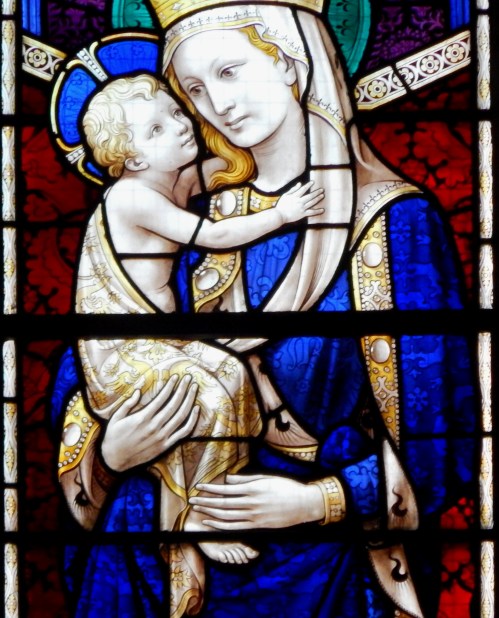
virgin & child by charles connick, 1916

Emmanuel Church in the City of Boston is an Episcopal parish located on Newbury Street. Consecrated in 1861 it is a masterpiece among the many architectural treasures to be found in Boston’s Back Bay. Its history as a place of worship and advocate for social justice for over 150 years are well documented on the church’s website. On the day that I and a friend visited to view the interior, an arts program for the homeless was concluding. Based on brief interactions with some of the participants it is clearly an empowering project, and just one of many offered in service to those in need. I hope to learn more in the future but on that day my focus was the stained glass windows. From the literature shared by one of the clergy, the stained glass artists whose work can be found in the church include John Ninian Comper, Charles Connick, Frederic Crowninshield, Harry Eldredge Goodhue, Heaton Butler & Bayne, Charles Eamer Kempe, Tiffany, Samuel West and Henry Wynd Young.

incredulity of st. thomas by tiffany glass & decorating, 1890

With expansion and construction into the 1920s, there are many different styles represented in the windows of Emmanuel Church.
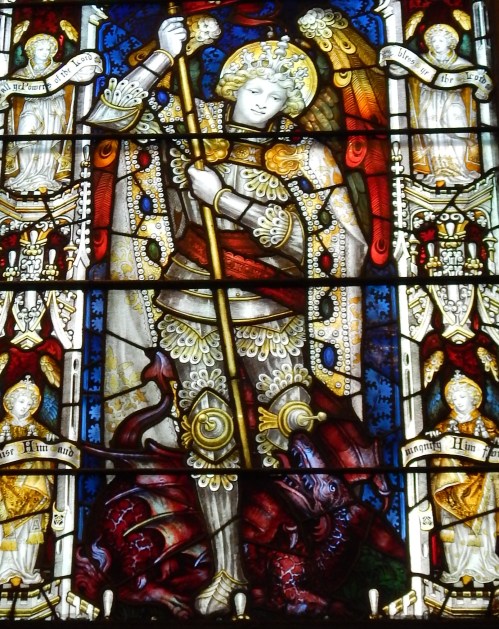
st. michael killing the dragon by charles eamer kempe, 1901


by harry eldredge goodhue, 1905

adoration of the magi by henry wynd young, after 1918


Windows have been lost over time.

Others have been beautifully restored including the church’s signature window, Emmanuel’s Land, comprised of 15 panels of leaded glass with 17 smaller sections of tracery above, and done in the opalescent style made famous by John La Farge, Louis C. Tiffany and Frederic Crowninshield. Emmanuel’s Land is one of Crowninshield’s largest works.
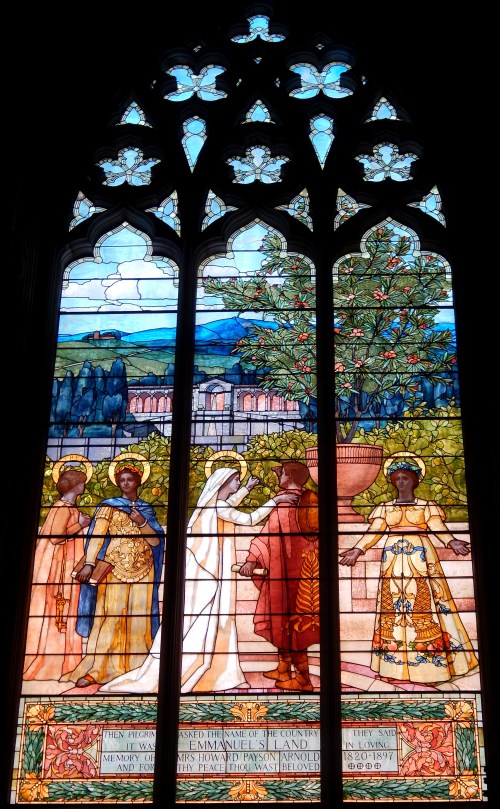
emmanuel’s land by frederic crowninshield, 1899
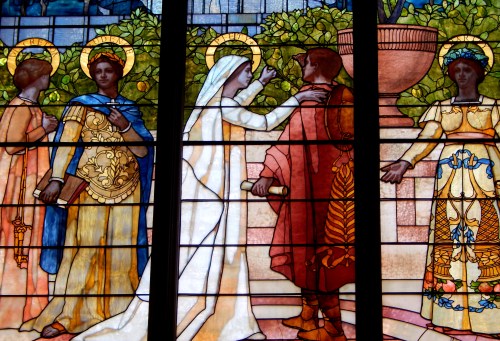
The window is especially notable because it does not depict a religious scene but instead a scene from John Bunyan’s book, The Pilgrims Progress.

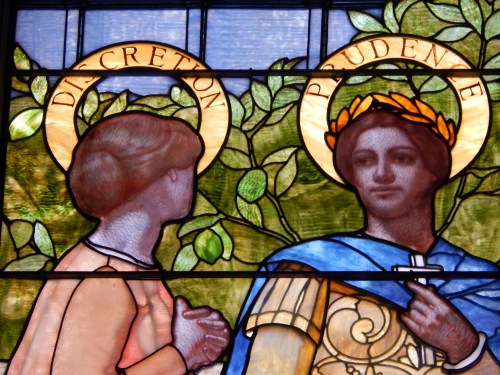
Piety, Discretion, Prudence and Charity show Pilgrim Emmanuel’s Land. The window was designed in memory of Mrs. Howard Payson Arnold, Crowninshield’s mother.
The windows are housed in a structure that has evolved quite a bit over its history from its original construction in 1861. As the parish grew, adjacent plots of land were purchased and new adjoining structures were built including a parish house, west transept, and two chapels. The Lindsey Chapel was the last to be built between 1920-1924. A poignant tale is at the heart of its construction but I shall save that story and those images for another post.
In this post I’ve shared just a brief glimpse of the windows inside this lovely church. I hope you have the chance to see firsthand. Learn more about the church via the following link:
Posted in Inspiration, Nature Notes, tagged beauty, colors, flowers, Inspiration, nature, Photography, red, urban landscape, water on April 12, 2016| 7 Comments »
Posted in Inspiration, Kitchen Inspirations, tagged colors, cooking, food, food photography, gardening, green, herbs, indoor gardening, Inspiration, joy, peas, Photography on April 12, 2016| 2 Comments »

pea tendrils
My indoor garden is in a bit of disarray. The nasturtium grew poorly in terms of foliage but continues to find strength to bloom. I’ve got peas in three little pots, their tendrils reaching for the sun. I need to decide soon if I will snip their tender tops to eat (the original intention) or let them grow tall and strong and possibly produce pods!

radish, nasturtium, and red kale greens
The radish are doing well … but I planted too many seeds and so now I have radish greens growing everywhere. Some of those little pots are designated as future salad greens, but I did find a few strong plants to put in one bigger pot. We’ll see if I can actually grow radishes indoors. I was very successful growing potatoes indoors. They were marble-sized but that doesn’t really matter. 😉
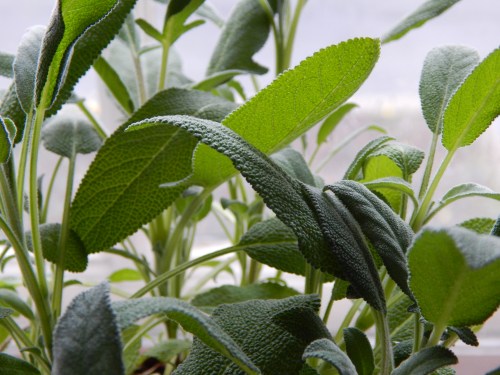
sage
The herbs are so far doing well. I’m looking forward to the chef in my life roasting some baby potatoes on a bed of sage and maybe doing something with grilled cheese and fresh basil.
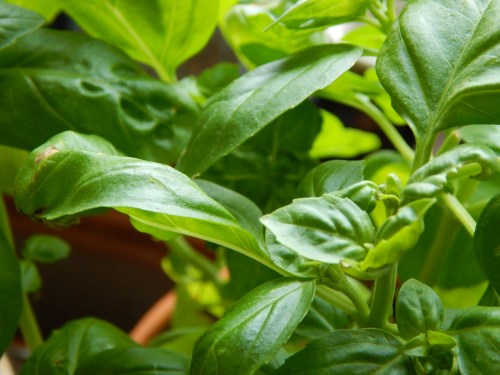
As wonderfully disorganized as everything is … I’ve got tarragon growing in a bathroom and rosemary in a bedroom … I cannot help but find joy in this garden and in the knowledge that the growing season has only just begun.
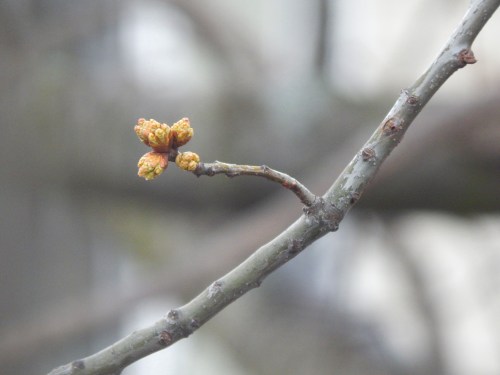
Posted in Branches, Inspiration, Nature Notes, tagged colors, Inspiration, nature, oak, Photography, spring, trees on April 11, 2016| 1 Comment »
Posted in Inspiration, tagged beauty, butterflies, colors, Inspiration, jewelry, Photography, pins, plique a jour, vintage on April 4, 2016| 1 Comment »

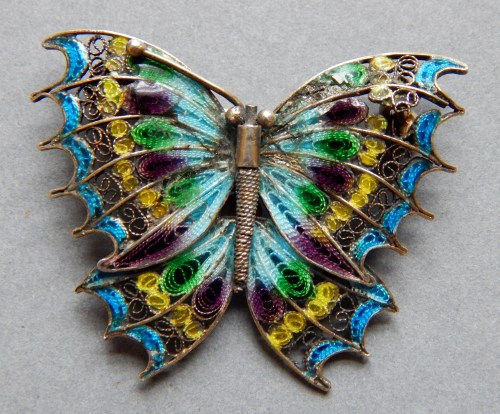
That’s the translation of the little slip of paper on the back of the butterfly, Plique a jour. An enameling technique similar to cloisonne but with no backing so that the light can shine through. It’s meant to be worn as a pin but I might turn it into an occasional suncatcher. A wonderful find in an old shop. A dainty little thing, bits of damage, an antennae missing. Still beautiful. And as much as the design, I like that idea of letting in daylight at any time of day.
Posted in Inspiration, tagged beauty, geodes, gifts, Inspiration, Photography, reflection, rocks, water on April 3, 2016| 3 Comments »
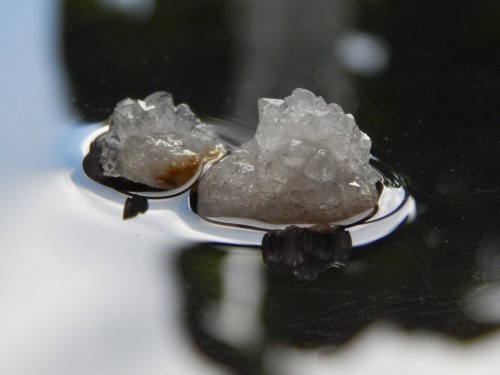
Rocks left on a church table. The little boy handed them to me. Looking at my camera, he asked, “Would you like to photograph these?” “Of course,” I said.

Posted in Inspiration, tagged beauty, bouquet, colors, flowers, humor, Inspiration, Photography, serenity, storytelling, white on April 1, 2016| 1 Comment »

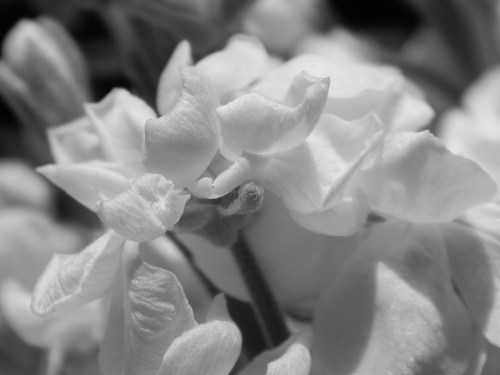
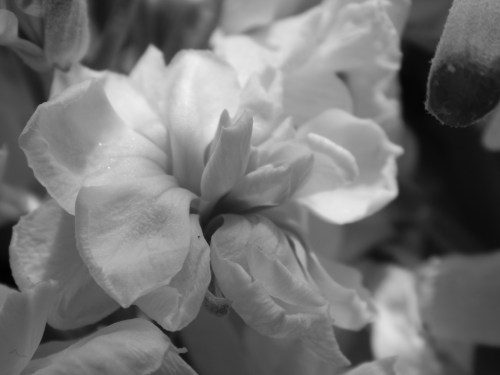
… and it fell apart so beautifully. A mammoth bouquet of white flowers with leaves of frosted green whose name I do not even know. I saw it sitting in a black bucket across the store and knew I had to have it. Back on the shelves went a sundry of things because I decided I needed that bouquet more than dark chocolate and such. It lasted a long time, that bouquet, and during chaotic times I could stare into its midst, with coffee in hand, and just breathe deep. And it was the breathing deep that got me in the end because after a while, darn allergies, the bouquet’s pleasant scent wasn’t so pleasant after all and so into the hallway it went. With hand over nose, I’d occasionally glance out at its soothing beauty until I needed to be soothed no longer. As it dried, it fell apart so beautifully.

Posted in Inspiration, tagged American history, beauty, black history, history, identity, Inspiration, Photography, race, storytelling on March 30, 2016| 1 Comment »
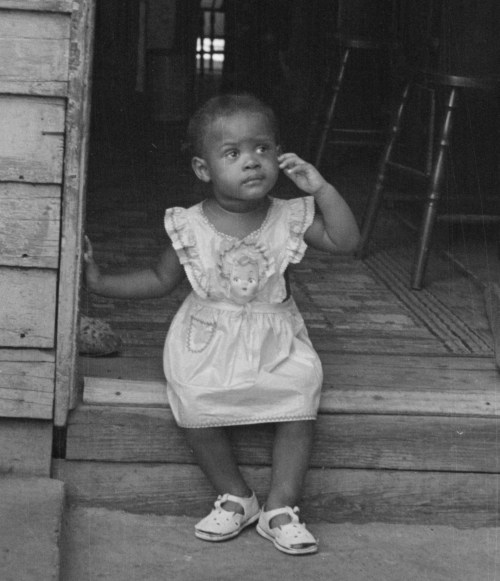
detail from untitled photo by joseph a. horne, 1940s
This photo was taken by Joseph Anthony Horne during the 1940s as he worked for the Farm Security Administration – Office of War Information. As highlighted in a previous chapter of Interludes, he like many other photographers had been sent out across the country, under the direction of Roy Stryker, to capture the American experience. One of the areas that Horne captured on film was southeast Washington, D.C., an area not far from where his family lived and an area that was predominantly African American. The photos he took in that community were notable, for me, in part because there was no characterization or stereotyping. He simply photographed in a straightforward manner people living their daily lives. He, like many of the FSA photographers, was very good at that. Otherwise in commercial media, unless it was an African-American specific publication, there was either no representation of “colored” people or it was often a mimicry. Out of all the photos that Horne took in this community, I was especially struck by the series of photos of this little girl who had been positioned in front of the camera by a person who appeared to be her mother. No doubt she’d been placed in a best dress for the occasion. And its that dress that caught my attention.

There are people far more eloquent and scholarly than I who have written and who continue to write about how we as humans form our sense of self, our sense of self-worth, our sense of what is beautiful and our sense of how we individually fit within that definition of beauty. This little girl is lovely and thoughtful. Her face clearly reads, who are you and what are you doing? The little face affixed to her dress is also lovely. Two different expressions of beauty.
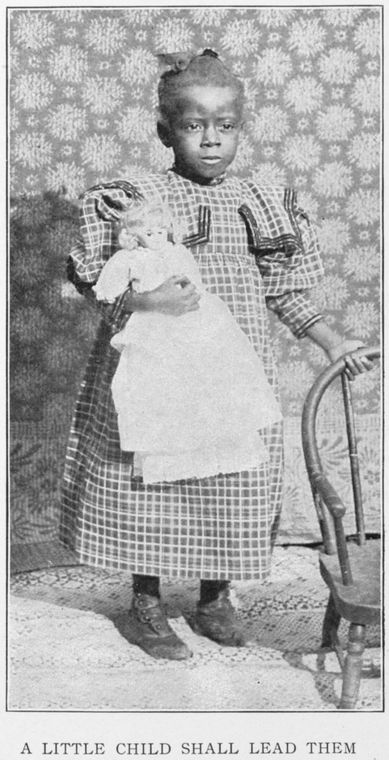
This photograph was taken in 1905 and is located in the NYPL Digital Collection. I don’t know the context in which this photograph was taken though there is that accompanying caption suggesting to me that it was in a magazine and meant as a positive image highlighting how far African Americans had come in the 40-years since slavery and that a new generation would have even more success. Too true as evidenced by the strength in that little girl’s face, and yet I am struck by the doll wrapped in her arm. Growing up in the 1970s, I too had a lovely doll around which to wrap my arms and I enjoyed combing her blonde hair and wondering why it was so hard, in fact impossible, to braid her hair the way my mother braided mine. I grew up in a far different time than these two young girls but Toni Morrison’s The Bluest Eye, published the year I was born, certainly resonated in my teenage years. I don’t remember ever wanting blue eyes but I think I wanted blonde hair (or maybe a lion’s mane).
These musings come to the fore because of a convergence of recent events, including having the opportunity to explore the imagery being made available through digital collections, seeing images of the past that had not been made widely available before, images that today have the potential to spark positive conversations about the past, present and future.
I recently pulled together research to tell two stories of one place. One story focused on two sisters of great wealth whose lives are well-documented and whose enduring influences are often remarked upon. The second story took great effort to pull together, of a gentleman whose image and good works I could only find because of the old texts and photographs being digitized and made available online. The two sisters were white and the gentleman was black. They lived during the same time period and interacted in the same place. When I printed my drafts and shared the stories with an elder (whose age I shall not share), she listened politely to the story of the two women but she took the story of the gentleman. We had a conversation and she said, “Cynthia, all my life I have heard about these women and the people like them. I never heard about this man. You keep doing your research. Why is it important? I want people to know that we were here. To know that we were a part of this place.”
Sources
https://www.loc.gov/item/owi2001000491/PP/
Schomburg Center for Research in Black Culture, Jean Blackwell Hutson Research and Reference Division, The New York Public Library. “A little child shall lead them.” The New York Public Library Digital Collections. 1906. http://digitalcollections.nypl.org/items/510d47df-9e16-a3d9-e040-e00a18064a99


 Words + Images