Feeds:
Posts
Comments
Detail from David's Charge to Solomon Stained Glass Window, Trinity Church in Copley Square

Detail from David’s Charge to Solomon Stained Glass Window, Trinity Church in Copley Square, by Burne-Jones and William Morris

Returning to the Trinity Church Book Shop are items with a detail I photographed from David’s Charge to Solomon, a stained glass window located in the church’s baptistry.  The magnificent window was designed by Pre-Raphaelite artist Edward Burne-Jones and executed by William Morris Studios in 1882.  These “four angels” are located in the upper left corner of the window.  There they look down upon David, near the end of his days, as he instructs his son Solomon in how to move forward in life as a man and as a leader of his people.

Items currently available are magnets, mugs and postcards.  Coming soon are totes and t-shirts.  Visit the Shop to view these and many more lovely and thought provoking spiritual items at 206 Clarendon Street, Boston, in the heart of Copley Square.  Shipping is possible.  For more Book Shop information, click here.  And to see additional details from the window David’s Charge to Solomon, please check out images 25-32 here.  Better yet, if you’re in the area, take one of the excellent guided tours so that you can see the window firsthand. 😉

orchid revisited

The sun finally shone bright, or at least, just bright enough to revisit the orchid.

out of the blackness

blue stone in water

blue stone in water in black bowl

One night a year or so ago, I entered my childhood home and walked into the kitchen.  The light was low and the air was warm.  I sat at the table with my mother, feeling welcomed as always.  Just as I did when I returned home from college, I began to tell her the stories of my daily life, the ups, the downs and all that lay in between.  I told her about the people I cared about and worried about.  I opened up a bit more than usual and began to share mistakes made and the opportunities I saw on the horizon.  I explained how I felt older, not sure about wiser,  but at least tempered by life and was looking forward to trying to apply some of the lessons learned.

blue stone in water, branches reflected

blue stone in water, branches reflected

She listened attentively, as she had always done, and on occasion, she smiled as I described some silliness of mine.  As I paused to take a deep breath, I admired how wonderful she looked, the smoothness of her caramel skin, the fullness of her brown hair reaching her proud shoulders, the strength in her arms, and the brightness of her eyes.  She was the strong woman of my youth, not the more fragile woman of my adulthood.  And yet I sat before her as an adult.

blue stone in water and branches reflected, in motion

blue stone in water and branches reflected, tilting the bowl

Still trying to catch my breath, I managed to say, “Ma, I’ve been telling you stuff that happened after you died, haven’t I?” She nodded. We stood and she pulled me into her arms.  She felt soft and warm and held me tight.  “That’s right, baby,” she said. ” And you’ve got a lot more stuff to do.  My time has passed but this isn’t your time.”  I woke up gasping for breath … which is what I had needed to do since I’d been having trouble breathing in my sleep.

rocks in water

rocks in water

I have not visited my mother’s grave, or my father’s, in well over a decade.  My main memories of the site are actually based on the stories my brother told of walking through the area with flower seeds in his pocket and letting them fall when the caretaker wasn’t looking.  I don’t know if those flowers ever bloomed but I feel like I carry them with me wherever I go, just as I carry my mother.  Or perhaps, she still carries me.

oak and rain

As I waited for the coffee to brew, I decided to snap a few photos of the morning rain beading on the oak tree towering beside the house.

For the most part, I focused through one or two panes of glass though at one point I did open a window and stick my head out.

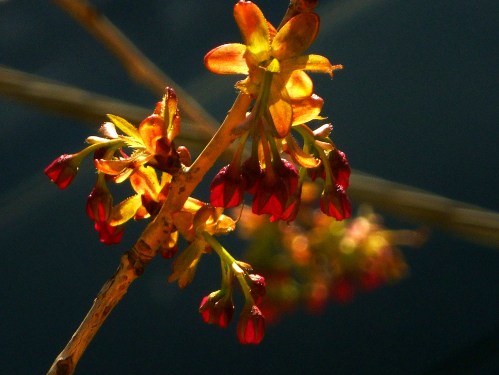
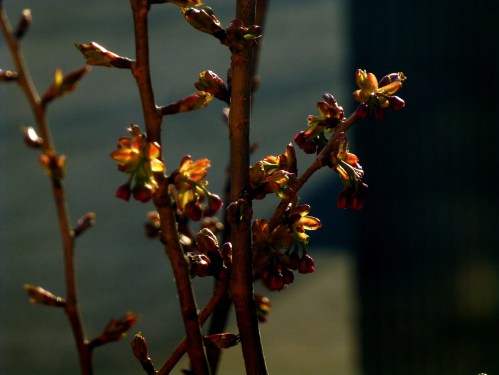
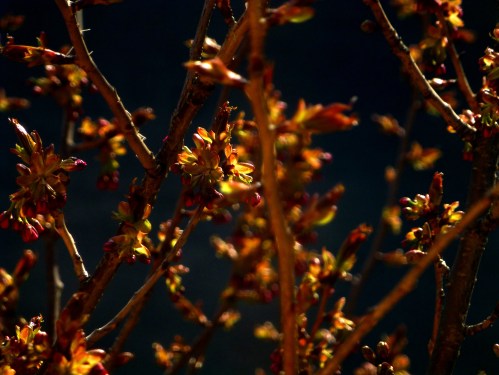
Despite the morning chill, it was neat to see the buds on the branches and the subtle colors emerging, suggesting spring blossoms and leaves will soon to be.

orchid

The major stems, leaves and unopened buds are jade green while the petals are pale green and freckled with apricot.  A lovely gift that now resides in the kitchen in the grayness of a rainy afternoon.

Many buds wait to open, and so we’ll see what happens in the coming days once the sun reappears in its gold cloak.

color combinations

Oh, yes, indeed.  I was intentionally playing with my food.

It had been a long day of working with words.  So, at the end of that day, the little kid in me just wanted to dabble in color.

I rose from my desk and walked real fast to the corner store, a Korean market where the owner always greets me with a smile.

She’s used to me now, sometimes entering her store, with no purpose, just to wander the aisles in a bit of a daze, trying to let go of a heady day.

But this day, I had a purpose.  I knew I wanted vegetables to carry home and chop up and photograph in the light of the setting sun.

I wasn’t really thinking dinner. Luckily, Steve always is and so when he returned home, I simply showed him my colorful palette and he saw cooking ingredients.  After a moment of thought, he nodded and said, “I can work with this.”  He would add white garlic and red onions to the mix, but no images of these items do I have for this post because by then I had put my camera away.

foreword to the interludes

interlude: genesis

interlude: exodus, part 1

interlude: exodus, part 2

Son of farmer in dust bowl area. Cimarron County, Oklahoma , photo by Arthur Rothstein, 1936.

Son of farmer in dust bowl area. Cimarron County, Oklahoma , photo by Arthur Rothstein, 1936.

“A gentle wind followed the rain clouds, driving them on northward, a wind that softly clashed the drying corn. A day went by and the wind increased, steady, unbroken by gusts. The dust from the roads fluffed up and spread out …  Now the wind grew strong and hard …  the dust lifted up out of the fields and drove gray plumes into the air like sluggish smoke. The corn threshed the wind and made a dry, rushing sound. The finest dust did not settle back to earth now, but disappeared into the darkening sky.”  — in the opening chapter of The Grapes of Wrath by John Steinbeck.

Liberal (vicinity), Kan. Soil blown by dust bowl winds piled up in large drifts on a farm, photo by Arthur Rothstein, 1936.

Liberal (vicinity), Kan. Soil blown by dust bowl winds piled up in large drifts on a farm, photo by Arthur Rothstein, 1936.

In April 1935, as Joseph A. Horne was teaching music in West Virginia, President Franklin Delano Roosevelt was creating the Resettlement Administration (RA) in Washington, D.C.  Guided by Rexford G. Tugwell, the agency intent was to help farmers and other rural poor suffering from the economic impacts of the Great Depression and the devastation of dust storms and other ecological events.   A Historical Section was created within the agency to document existing poverty as well as report the benefits of the agency’s work.  This section would be led by Roy E. Stryker.

Rexford Tugwell and Roy Stryker

Rexford Tugwell and Roy Stryker

In the 1920s, Tugwell and Stryker, both economists, had taught at Columbia University.  While there, they had collaborated on the book, American Economic Life. Stryker’s contribution included using photography to complement the text, something he also did as part of his lectures at the university.  He was not a photographer but he, and Tugwell, recognized photography as a useful, illustrative tool to convey and strengthen information.

Farmer and sons walking in the face of a dust storm. Cimarron County, Oklahoma, photo by Arthur Rothstein, 1936.

Farmer and sons walking in the face of a dust storm. Cimarron County, Oklahoma, photo by Arthur Rothstein, 1936.

Stryker left academic life to follow his friend and mentor to the Resettlement Administration. Three decades later, Stryker would recount that “Tugwell never said, “Take pictures.”  He said, “We need pictures.”  He never said how to take them.  He said, “Remember,” — and this is the only thing I can remember — “remember that the man with the holes in his shoes, the ragged clothes, can be just as good a citizen as the man who has the better shoes and the better clothes.” (Interview, June 13, 1964)

Farmer, local type, Brown County, Indiana, photo by Theodor Jung, 1935.

Farmer, local type, Brown County, Indiana, photo by Theodor Jung, 1935.

The agency’s original focus was on Rural Rehabilitation, Rural Resettlement, Land Utilization and Suburban Resettlement.  Activities included purchasing exhausted farmlands from farmers to convert the land into pastures or parks, for instance, and providing training for farmers to rehabilitate their farms through refinancing and other debt adjustments.  Out of work farmers were given jobs.  Building projects were begun.  The most controversial feature of the agency’s efforts was relocation.

Scottsboro (vicinity), Alabama. Farmers who have been resettled at work in a sand pit at Cumberland Mountain Farms, a U.S. Resettlement Administration project, photo by Arthur Rothstein, 1935.

Scottsboro (vicinity), Alabama. Farmers who have been resettled at work in a sand pit at Cumberland Mountain Farms, a U.S. Resettlement Administration project, photo by Arthur Rothstein, 1935.

From the beginning, the agency did not have much Congressional support.  Part of it was political.  Tugwell was considered to be one of the most radical of FDR’s New Dealers.  Plus the idea of relocating nearly a million farmers and other rural poor off the land into cities that they’d helped to build seemed too socialistic.

Rehabilitation client, Garrett County, Maryland, photo by Theodor Jung, 1935.

Rehabilitation client, Garrett County, Maryland, photo by Theodor Jung, 1935.

With funding limited by Congress, the Resettlement Administration would eventually dramatically narrow its efforts and focus on building relief camps in California for migratory farm workers.  One of these relief camps would inspire John Steinbeck’s The Grapes of Wrath.

All races serve the crops in California, photo by Dorothea Lange, 1935

All races serve the crops in California, photo by Dorothea Lange, 1935

Faced with rising criticism for his management, Tugwell resigned from the Resettlement Admininistration in 1936.  By September 1937, the agency was folded into a new federal entity, the Farm Security Administration (FSA).  The FSA, with its mandate to help the rural poor, would complete some of the Resettlement Administration’s original projects as well as embark upon a whole other series of financial and technical assistance programs.  Roy Stryker was given the greenlight to continue his documentary photography program.

Negro field worker. Holtville, Imperial Valley, California. He has just made himself shoes out of that old tire, photo by Dorothea Lange, 1935.

Negro field worker. Holtville, Imperial Valley, California. He has just made himself shoes out of that old tire, photo by Dorothea Lange, 1935.

He directed his photographers to take the best picture possible and to capture the story behind the image.  He could not tell them how to use their cameras, but he did suggest themes to focus on.

Imperial Valley, California, Mexican. He tells his story: he helped drive the French out of Mexico, fought against Maximilian, and he has, by serving the crops for many years, help build up Imperial Valley, photo by Dorothea Lange, 1935.

Imperial Valley, California, Mexican. He tells his story: he helped drive the French out of Mexico, fought against Maximilian, and he has, by serving the crops for many years, help build up Imperial Valley, photo by Dorothea Lange, 1935.

Based on how they operated in the field, these early documentary photographers, including Dorothea Lange, Walker Evans, Ben Shahn and Arthur Rothstein, were sometimes described as “sociologists with cameras.”

Mexican field worker, father of six. Imperial Valley, Riverside County, California, photo by Dorothea Lange, 1935.

Mexican field worker, father of six. Imperial Valley, Riverside County, California, photo by Dorothea Lange, 1935.

The photographers traveled across the nation, by assignment, sometimes alone and sometimes in groups, to areas of economic challenge, capturing dramatic hardships and also simply documenting people living their daily lives.

Untitled photo, possibly related to: Miners at American Radiator Mine, Mount Pleasant, Westmoreland County, Pennsylvania, photo by Carl Mydans, 1936.

Untitled photo, possibly related to: Miners at American Radiator Mine, Mount Pleasant, Westmoreland County, Pennsylvania, photo by Carl Mydans, 1936.

Farmer and sons walking in the face of a dust storm. Cimarron County, Oklahoma, photo by Arthur Rothstein, 1936.

Warm Springs Indian boy. Molalla, Oregon photo by Arthur Rothstein, 1936.

The FSA would operate from 1937 – 1942, with its photography unit capturing the diversity of the United States.

Negro boys on Easter morning. Southside, Chicago, Illinois, photo by Russell Lee, 1941.

Negro boys on Easter morning. Southside, Chicago, Illinois, photo by Russell Lee, 1941.

That diversity would be represented in the ranks of the photographers that Stryker brought together, men and women of different backgrounds, interests, and photographic skill.

Westmoreland project, Pennsylvania. Westmoreland County. Construction worker on the Westmoreland subsistence homestead project, photo by Walker Evans, 1935.

Westmoreland project, Pennsylvania. Westmoreland County. Construction worker on the Westmoreland subsistence homestead project, photo by Walker Evans, 1935.

In 1942, the photography unit moved into the Office of War Information (OWI)The OWI was created shortly after U.S. entry into World War II as an effort to consolidate existing government information services.

Two children in Anacostia, Washington, D.C. at the Frederick Douglass Housing Project, photo by Gordon Parks, 1942.

Two children in Anacostia, Washington, D.C. at the Frederick Douglass Housing Project, photo by Gordon Parks, 1942.

By 1943, another federal agency, the Office for Emergency Management, would  also be brought under the OWI umbrella, and its activities and some of its staff would merge with Roy Stryker’s photographic unit.  One of those staff would be Joseph A. Horne.

Chicago, Illinois. In the waiting room of the Union Station, photo by Jack Delano, 1943.

Chicago, Illinois. In the waiting room of the Union Station, photo by Jack Delano, 1943.

As these many agencies consolidated into one, the Farm Security Administration-Office of War Information (FSA-OWI), the nature of the photographs taken by its photographers changed to some degree as did the purpose of the images.

Office of War Information news bureau. Ted Poston, Negro desk editor of the Office of War Information (OWI), discusses a letter from one of the 240 Negro editors to which he sends war news from Washington, with William Clark and Harriette Easterlin, his assistants, photo by Alfred T. Palmer, 1943.

Office of War Information news bureau. Ted Poston, Negro desk editor of the Office of War Information (OWI), discusses a letter from one of the 240 Negro editors to which he sends war news from Washington, with William Clark and Harriette Easterlin, his assistants, photo by Alfred T. Palmer, 1943.

Documenting American life was still important but now with an emphasis on framing the images so that they would inspire patriotism, educate people about how to live and act during war time,  and evoke a sense of national pride in the strength, good humor and resilience of the American people.

Women in industry. Tool production. Arms for the love of America! The capable young woman whose strong hands guide this cutoff machine is one of a Midwest drill and tool factory's many women employees. Almost 1,000 women have recently been employed in this comparatively new plant; sole men workers, other than foreman, are those in the heat treating department. Republic Drill and Tool Company, Chicago, Illinois, photo by Ann Rosener, 1942.

Women in industry. Tool production. Arms for the love of America! The capable young woman whose strong hands guide this cutoff machine is one of a Midwest drill and tool factory’s many women employees. Almost 1,000 women have recently been employed in this comparatively new plant; sole men workers, other than foreman, are those in the heat treating department. Republic Drill and Tool Company, Chicago, Illinois, photo by Ann Rosener, 1942.

Joseph Horne’s photos that appear in the FSA-OWI Collection, now housed in the Library of Congress, focused on the Washington, D.C. area where he had settled with his family.  His images include the crafting of victory gardens and urban farms.

Washington, D.C. Children with rabbits which were formerly kept as pets, but now are being raised for food, photo by Joseph A. Horne, 1943.

Washington, D.C. Children with rabbits which were formerly kept as pets, but now are being raised for food, photo by Joseph A. Horne, 1943.

He also photographed the unique monuments located in the Congressional Cemetery, and the mix of peoples who made their way through Washington’s Franklin Park. And then there was that night in February 1944, when he photographed the opening of a new labor canteen.

Washington, D.C. Pete Seeger, noted folk singer entertaining at the opening of the Washington labor canteen, sponsored by the United Federal Labor Canteen, sponsored by the Federal Workers of American, Congress of Industrial Organizations (CIO), photo by Joseph A. Horne, 1944

Washington, D.C. Pete Seeger, noted folk singer entertaining at the opening of the Washington labor canteen, sponsored by the United Federal Labor Canteen, sponsored by the Federal Workers of American, Congress of Industrial Organizations (CIO), photo by Joseph A. Horne, 1944

The photography unit was only one part of the FSA-OWI but it was one of the most successful units.  Through domestic and overseas operations, the  agency had sought to excite and educate Americans at home, and inform (or intimidate) allies and foes abroad, using radio broadcasts (e.g. Voice of America), newspapers, posters, film and photography. But as World War II progressed, conflicts arose around agency management and how to balance civilian and military interests.  Soon, Congress would severely cut the organization’s budget. By 1944, the enormous collection of FSA-OWI photos, black and white and color, would be transferred to the Library of Congress where they remain a valuable resource to this day.

Negro boy near Cincinnati, Ohio, photo by John Vachon, 1942 or 1943.

Negro boy near Cincinnati, Ohio, photo by John Vachon, 1942 or 1943.

By 1945, the Office of War Information as an organization was no more.  Any relevant international activities were transferred to the U. S. State Department, while relevant information gathering and related responsibilities were handed over to the intelligence agencies like the Office of Strategic Services/Central Intelligence Agency.

Joseph Jr. with Camera, photo by Joseph A. Horne.

Joseph Jr. with Camera, photo by Joseph A. Horne.

By the spring of 1944, Joseph A. Horne, the fellow with whom we are walking through history, had enlisted in the U.S. Army.  Soon he would be off to Europe where photography would remain an important feature of his life.  But before he traveled overseas, he would let his son play with one of his cameras.

Additional Reading/Sources …

Library of Congress Prints and Online Catalog

Stryker’s Shooting Scripts

Resettlement Administration

Farm Security Administration

Office of War Information

Oral Interviews with Roy E. Stryker

About Roy E. Stryker

Out of One, Many:  Regionalism in FSA Photography

Stryker and the FSA

John Steinbeck

FDR Presidential Library and Museum


yesterday’s sunset

love

Of late, I’ve met a man from a war-torn country who now lives and works in the U.S.  He has described to me scenes of great brutality inflicted by man upon man for reasons like this person looked like someone from that country versus this country.  He often has a smile on his face.

I am noted for seeing even an empty glass as half-full, but this man’s ability to find the positive puts me to shame.  Why is he so happy?  Not because he has a job that pays exceptionally well. He doesn’t.  Not because he’s made many new friends in this country.  He hasn’t.  I think it is because, even as the soil ran red with blood around him, he remained open to the possibilities.  He saw the beauty amidst the horror, like the flowers blossoming near that same bloody field.

He remained hopeful.  Or, as he once told me, he has love in his heart and so long as you have love, what else do you need? Hmmm.

One day I did chance upon him not smiling. I asked the first question that came to mind. “Do you still have love in your heart?”  He did not react with surprise to my words.  His brow furrowed in deep thought.  After a moment, he nodded, and then he smiled broadly.  “Yes, Cynthia.  Yes I do!”

I’m sure my mother would be appalled at how dusty I allow my windows to remain.  Yet occasionally when I glimpse the morning, afternoon or evening light striking the chalky surfaces, what I see is a strange beauty.

And when such a sighting occurs … which is probably far too often … I try to capture something of what I see.  I move fast and don’t think about camera settings, and so sometimes my camera is unfocused.

Or I purposefully try to zoom in ways that I know my little camera really can’t do but I do it anyway because I suspect I might see something really cool on the camera display.  And I do.

What I see on the camera display will sometimes … not always, but sometimes … make me smile or make me wonder.  No specific words will come to mind, just a sensibility that can sometimes be hard to explain.  Those feelings are all the motivation I need to keep shooting for just a bit longer.