Feeds:
Posts
Comments

Posts Tagged ‘art’

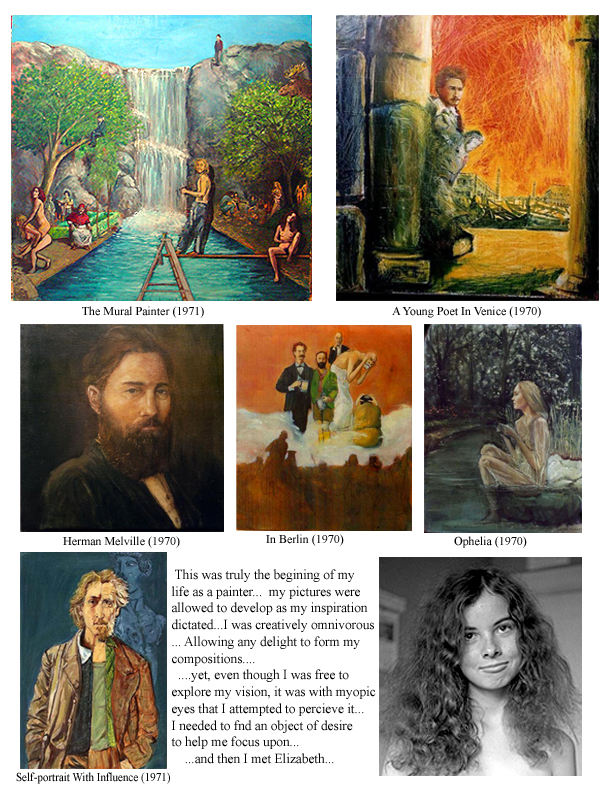
Sometimes when I am in a room with a group of people, someone will say, “Be careful what you say. We have a writer in our midst and she always sees a story.” I don’t know that I always see a story, but in this case I do.  It is the story of a man and a woman, two artists in their own right, who formed a union. A painter-poet and his writer muse.  Donald and Elizabeth Langosy.

I have permission to call him Donald but, since I am friends with his daughter Zoe, my southern upbringing drives me to refer to him as Mr. Langosy . Now, Elizabeth has made clear, that since we are writing colleagues, I am to call her Elizabeth.  And when she tells you to do something, what else is there to do but what she said in that gentle but oh so firm way of hers. She has that way about her, like a force of nature. Perhaps that is what drew Donald to her. That is his story to tell and, in part, that is what he has begun to do in the pages that his daughter helped him put together, The Story of My Art by Donald Langosy.

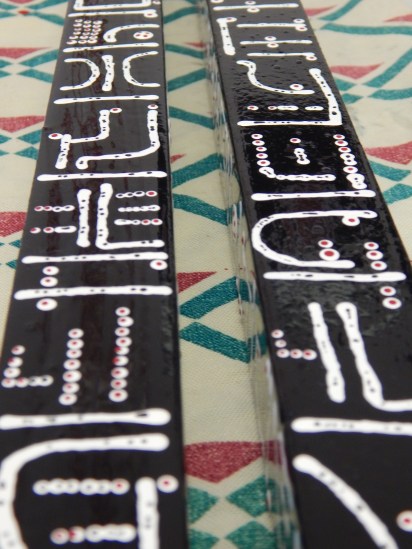
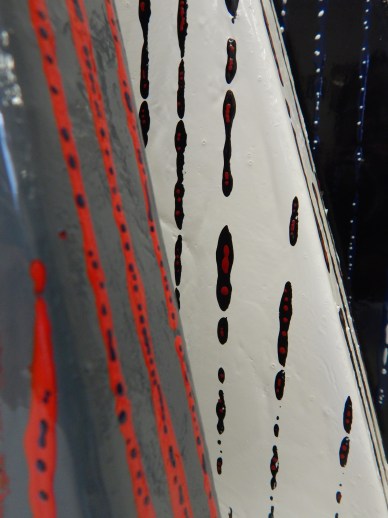
In these 14-pages a veil is pulled aside and we the viewer become privy to the bright life of a talented man and his love for a talented woman. We see how that love has enabled and empowered him to produce a body of work that is dynamic, vibrant, sometimes humorous, sometimes sad, and always provocative.

Below are two pages from The Story of My Art. Click on each image for a larger view. Over the course of the next six Thursdays the rest of the story will be shared. Join me on a journey …

For more information about Langosy’s art, contact Zoe at zlangosy@me.com.

Read Full Post »

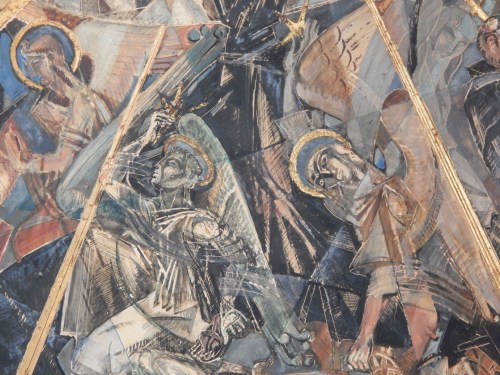
St. Dominic’s life is on display in Stephen’s living room. Grand in its expression, it appears in a small painting on paper, only slightly larger than 2′ x 2′ unframed. It is in fact the colorful sketch for a much larger work — a mural on the wall of St. Dominic’s Priory in Washington, D.C.

Each section of the painting, and of the final mural, has meaning. The image is divided into seven parts, depicting seven scenes from Dominic’s life, from the center upper part where “God’s Hand puts halo around St. Dominic and drops into beggar’s bowl a star …” to the center lower part where “Two Angels lift the saintly pilgrim by his bleeding feet toward the stars in heaven.

The painting was in the possession of Ludwig Joutz (1910-1998), an architect with the D.C. based firm, Thomas H. Locraft and Associates, noted for what today is often described as sacred architecture. In 1960, his company designed a new priory for St. Dominic’s Church. Construction was completed in 1962.  On a lined office pad Joutz sketched the initial concept for the mural. That yellowing piece of paper remains with the painting, a painting that is signed and dated by artist Pierre Bourdelle (1901-1966).

Loutz must have treasured Bourdelle’s work.  After he retired, he and his wife moved to Florida and with him he carried Bourdelle’s painting. Loutz, himself an artist, would sketch the interior of his home in Florida. In one drawing there on the wall is the same painting that Loutz’s son would eventually give to Stephen after his father’s death.

artwork by ludwig joutz

artwork by ludwig joutz

Ludwig’s son remembered his father meeting with Bourdelle as he worked on the mural but little else could he tell me and so my research began. Thankfully, there was quite a bit of information to be found online and in newspaper archives.

Born in Paris, France, Pierre Bourdelle was the son of famed sculptor Antoine Bourdelle.  He studied under Auguste Rodin in whose studio his father worked from 1893-1908. During his time as Rodin’s chief assistant, his father taught the likes of Henry Matisse and Alberto Giacometti. One biographer notes that with Rodin, a young Bourdelle visited Europe’s great Cathedrals.

rodin by edward steichen, 1911

rodin by edward steichen, 1911

Eventually Pierre would move to the United States and set up a studio in New York. In effect, he stepped out of his father’s shadow.

antoine bourdelle, 1925

antoine bourdelle, 1925

In a 1934 interview, he expressed: “In France, a man is judged by what his father did or by his family tree. In the United States a man is judged by himself, his personality, his own work. In France, they offered me mural jobs because my father was a well-known artist. They did not even look at my work.

pierre bourdelle, 1934

pierre bourdelle, 1934

A man of diverse interests and talents, he’d traveled the world studying the art of different cultures, observing the nature of different places.  Over time, based on some of the things he’d seen, he developed a new technique that set him apart as a muralist.

excerpt from 1934 article

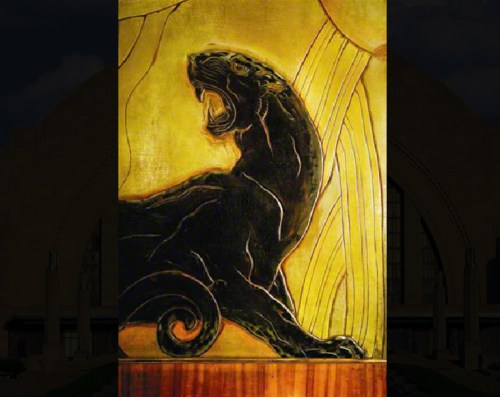
Search online and you’ll find a wealth of information about his Art Deco paintings and sculptures from the 1930s and 1940s. His bold and vibrant work adorned the interiors of ocean liners, railway lines like the California Zephyr, and the walls of institutions like Union Terminal in Cincinnati.
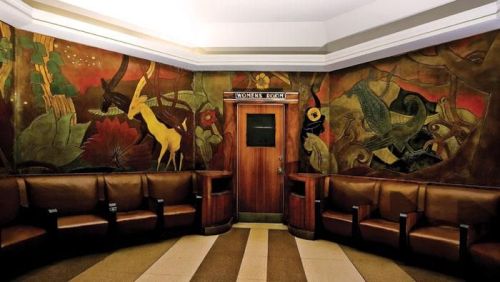
jungle mural by bourdelle for cincinnati terminal

He was a versatile artist capable of working with many media.  For Cincinnati’s Union Terminal, he not only created exotic jungle murals carved in linoleum, he also painted the ceilings of several rooms using an electric spray gun on canvas.

For the 1939-1940 New York World’s Fair, he created murals for Food Building North No. 2.  As described by a journalist covering the fair for Collier’s Magazine in 1939, There was Pierre Bourdelle, stripped to the waist in the hot sun and covered with red plaster dust. Gobs of wet plaster, a good blank wall, tools in his hands. That’s all Bourdelle, pupil of Rodin, asks to make him happy.”

His design motif for the fair was described as low bas-relief representing Bacchantes reveling at a wine-harvest festival, mythological animals, and scenes of beverage-making in various cultures.

sunshine and rain by bourdelle 1939

larger detail of vineyard mural on food building, 1939
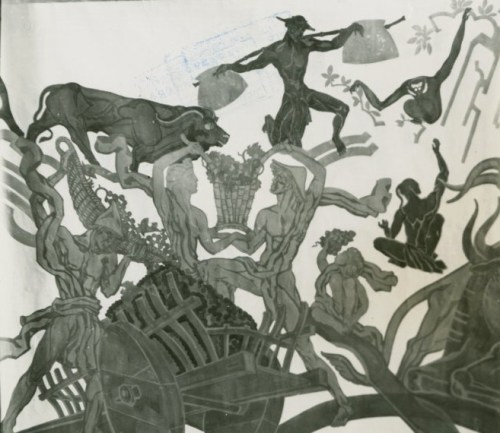
Vineyard by Bourdelle 1939

While not everyone appreciated his style, e.g. so many sinuous forms wrapped around each other, few could deny the provocative and captivating nature of his work.

When World War II broke out, Bourdelle felt compelled to join the war effort.  He’d served in France during World War I. He’d been too young, only 15, but he’d lied about his age and was able to join an aviation unit.  When his plane went down, he suffered traumatic ear injuries.  A number of the biographies I found suggest that the horrors of that first war, the so-called Great War, influenced his art as no doubt did his participation in World War II. While unable to enlist because he was considered too old, he did serve in his own way, as a volunteer ambulance driver with the American Field Service at the North African and Italian fronts.

In 1945, upon his return to the U.S., Bourdelle would produce a book of images, simply titled, War. For the foreward, Stephen Galatti , the Director General of the AFS, would write, “Overseas Pierre Bourdelle saw suffering. He did his best to alleviate suffering, driving the wounded soldiers of many Allied armies. Helping staunch and bind their wounds in the field dressing stations. He knows the agony of war. He has no fear of showing war at its useless worst. He is not only a personally brave man who volunteered to go, and went, wherever the wounded were. He is an intellectually brave man, who makes no pretense at hiding the bare hideousness of warfare. … They are not pretty pictures. They show nothing but reality …”

Et Quare Tristis Incedo

They may not be pretty but they are horribly beautiful.  And as I perused all 50+ images, viewable online here, I could not help but be fascinated by Bourdelle’s evolution as an artist …
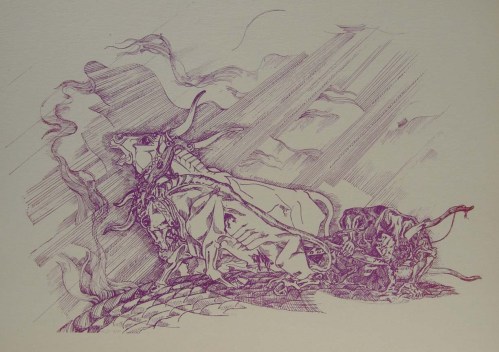
Land Mine

… seeing these works done in the 1940s and then …
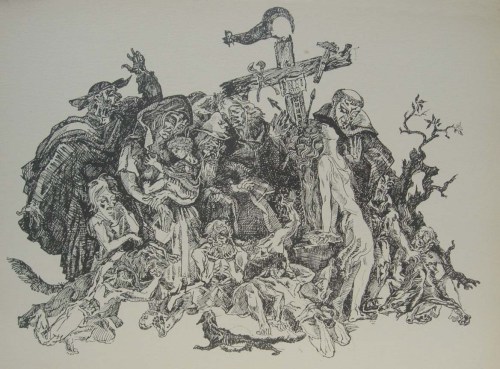
Calvalry

… being able to look at the drawing he did in the early 1960s for the St. Dominic mural.

I suspect I will never see in-person the actual St. Dominic mural.  First of all, it is in a monastery chapel. Second of all, it has been covered in an attempt, I believe, to preserve it from the deterioration of time.

During the latter years of his life, Pierre Bourdelle continued to work as an artist and as a teacher.  He taught at C. W. Post, part of Long Island University, as an artist-in-residence. He died in 1966 while traveling with his family in Switzerland.


Sources and Additional Reading

Bourdelle Family History – http://www.mountharmonyfarm.com/GH-P-BourdelleItems.html

SS America Unique Story of a Great Ocean Liner/Bourdelle Page – http://www.ssamerica.bplaced.net/art2-en.html

Artwork for the California Zephyr – http://calzephyr.railfan.net/artists/bourdelle.html

Manuscripts and Archives Division, The New York Public Library. “Art – Murals – Food Buildings – The Vineyard (Pierre Bourdelle)” The New York Public Library Digital Collections. 1935 – 1945. http://digitalcollections.nypl.org/items/5e66b3e8-7352-d471-e040-e00a180654d7

Collier’s, Volume 103, p. 16

Bourdelle Art for Dallas Fair Park – http://frenchsculpture.org/dallas-fair-park-1

https://en.wikipedia.org/wiki/Cincinnati_Museum_Center_at_Union_Terminal

The Glass Storybook and the Great Menagerie The Art of Winold Reiss and Pierre Bourdelle – http://www.cincymuseum.org/union-terminal/art

History of Cincinnati Union Terminal – http://library.cincymuseum.org/75th-anniversary/main.swf

Bourdelle’s War – http://www.ourstory.info/library/4-ww2/Bourdelle/pbTC.html

Bourdelle Papers at Syracuse Libraries  – http://library.syr.edu/digital/guides/b/bourdelle_p.htm


Read Full Post »

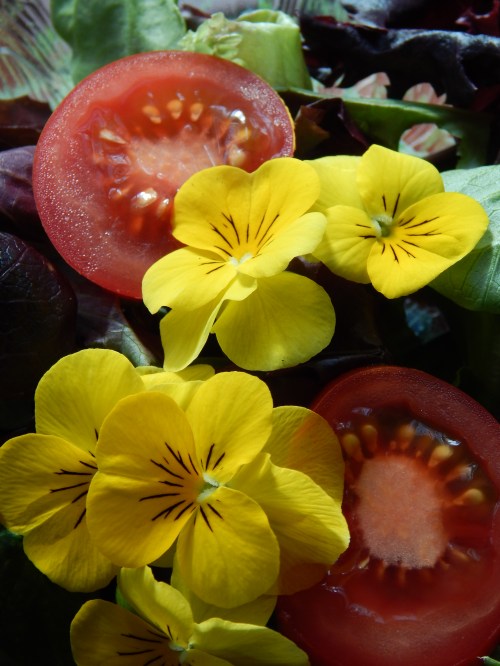
After confirming that the flowers were edible, Ricky of Ricky’s Market asked me to tell him how they tasted. Well, they don’t taste like much to me, but what wonderful brightness they add to a salad. Like sunlight.

I have to return to Ricky’s soon and I am contemplating picking up some white flowers. If I place their petals upon the dark green leaves of spinach and kale will I be reminded of the moon this time? We shall see. 🙂

Read Full Post »

illustration by zoe langosy

illustration by zoe langosy

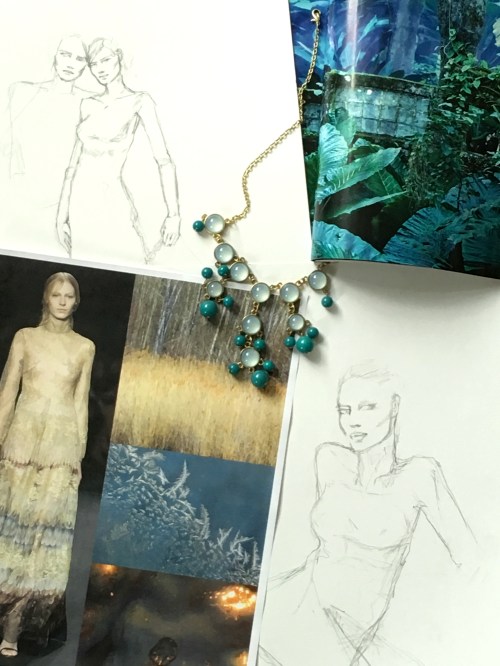
Pencil has met paper. Lines have been drawn. Soon images will be cut and painstakingly applied to a sensuous form. An original concept has evolved with the core idea the same — figures clothed by nature. My photography as the “fabric” in the hands of fashion illustrator Zoe Langosy.  Here’s a sneak peek at her current work in progress, a rendering of a Valentino dress to be collaged with three of my photos.

creative swatch by zoe langosy

creative swatch by zoe langosy

In her own words: What has surprised me about the evolution of this work is that the initial drawing was classical in its rendering in part because Valentino is so classical, his fashion prim and romantic.

illustration by zoe langosy

illustration by zoe langosy

But after the initial drawing which echoed that romantic sentiment, I lost interest and began a new drawing, one more dynamic and sensual. The wonderful challenge for me is to use the Valentino dress in a different way, to take this beautiful classical garment by a master designer, and render it with a darker edge that’s more inline with my own artistic style.

photo courtesy of zoe langosy

The artist is at work, ladies and gentlemen. Stay tuned for future updates. New to this story of a unique collaboration?  Read more here: a new year and new collaborations and here fashion plus nature equals

http://www.zoe.langosy.net/

Read Full Post »
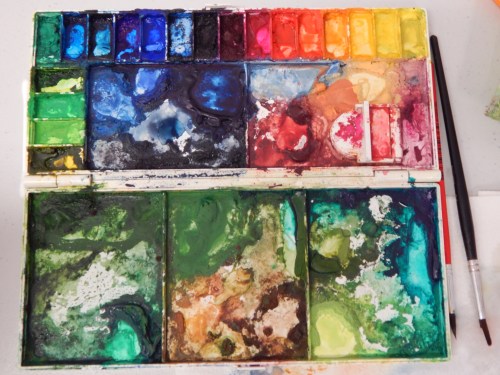
painter's box of carol moses

painter’s box of carol moses

Visit the Riverside Gallery at the Cambridge Community Center from noon to 6pm today.  See artists at work. View their paintings, sculpture, photography and more.  Pieces are available for purchase including small totems by Cedric Harper (read more about this amazing artist here and here)

DSCN6785

beautiful paintings by Adriana Prat (read more about her artistic expression here) …

vibrant works by Jenny L. Grassl blending words, letters and the visual

bold inks and watercolors by Carol Moses

and new work by artist Maki Takano

and I’ll be there!

Riverside Gallery 5 Callender Street, Cambridge


Read Full Post »
one of two stained glass windows by daniel maher stained glass

one of the two windows depicting, “pentacost,” by daniel maher stained glass

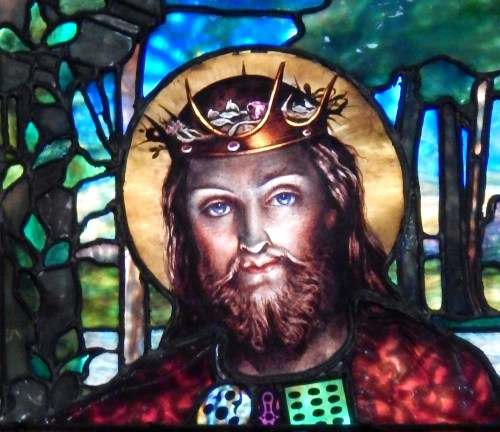
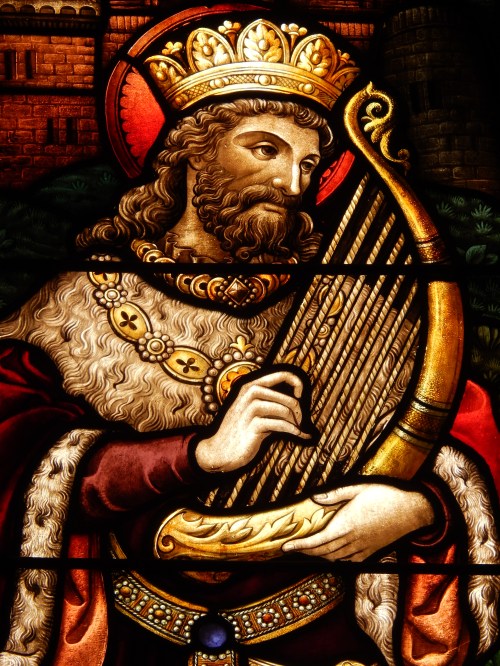
These windows at St. James’s Episcopal Church by local artisans Daniel Maher and Lyn Lovey express a creativity and diversity that is very modern. It is almost startling to look up and see them in the clerestory after viewing older works by Tiffany, Clayton & Bell, Goodhue and others in other parts of the  building. In part that’s because of my own ignorance around stained glass making today and how churches continue to commission their design and installation. Working with glass remains a popular and contemporary art. And in places like St. James, the past and present harmonize quite nicely.

one of a pair of windows designed by lyn hovey stained glass

I’ve lived in Boston for almost twenty years and I can’t even imagine how many times I’ve walked along Massachusetts Ave past this church. When I’ve been tired I’ve stepped into its adjacent garden and sat on the church steps. I’ve always wondered, what was behind the red stone? I’m grateful to the rector, sexton and other staff for allowing me to appease my curiosity and glimpse the beauty inside. Until you can make your visit, below are a few images for you to enjoy. And there’s also a link to a very interesting overview of the windows available online.

Detail from chancel windows …

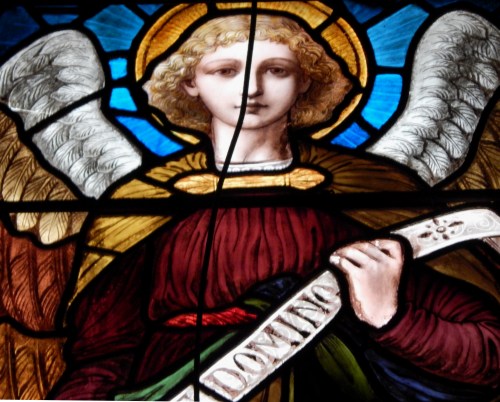
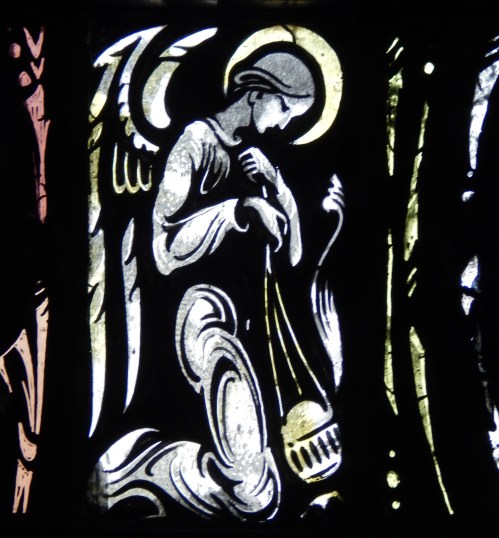
Detail from one of the choir angel windows …

Detail from the Resurrection window…

Detail from David with Harp …

Detail from Dorcas window …

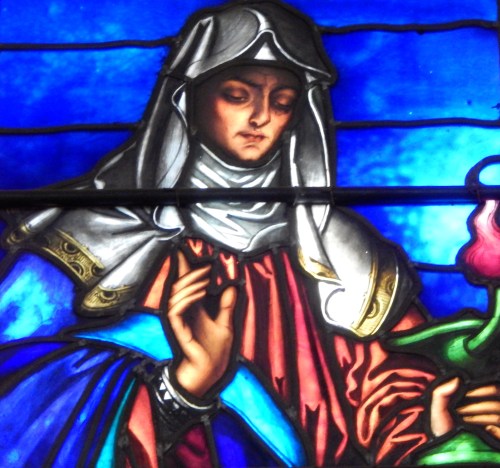
Detail from Saint Dorothea window …

Detail from the Greenleaf window …

Detail from the Nativity window …


Additional Reading and Links

St. James’s Episcopal Church

Overview of St. James Stained Glass Windows

Daniel Maher Stained Glass

Lyn Hovey Stained Glass


Read Full Post »

detail from rice memorial window “christ the light of the world”

As you travel along Massachusetts Avenue in Cambridge, just outside of Porter Square, you will find St. James’s Episcopal Church, a beautiful stone structure designed by Henry Martyn Congdon in a Richardsonian Romanesque style. While the church was founded in 1864, the cornerstone of the particular building in which I peered today was laid in 1888.  Inside is quite a variety of stained and painted glass (and a bell re-cast by Paul Revere!).

While I visited at the wrong time of day and time of year for the best effect, the opalescent windows along the west wall still caught my attention. I visited in early morning in spring but for the windows to be seen as their designers — John La Farge and possibly Tiffany — intended, I will need to visit again in winter in the late afternoon just before sunset.

detail from "jesus the good shepherd"by john la farge

detail from “jesus the good shepherd” by john la farge

I’ve already marked my calendar. 🙂

detail from the batchelder-dexter window, “the mission of the seventy”

I’m still sorting through pictures and their stories. More to come from my delightful visit. Meanwhile you can learn more about the church, its people and the history of the building here: http://www.stjames-cambridge.org/

Read Full Post »

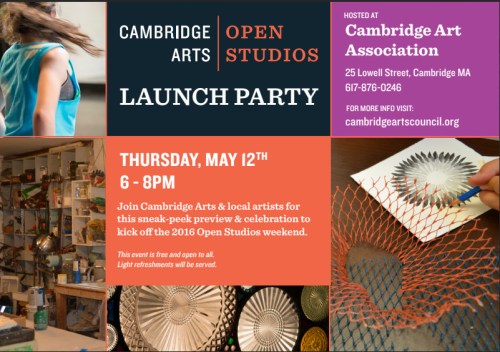
Come one, come all, to the Cambridge Art Association’s Open Studios Launch Party on Thursday May 12th from 6-8 PM. Free and open to the public. Light refreshments and wine will be served.  Meet many artists from across Cambridge. Hope to see you there and during the actual Open Studios weekend. I’ll be participating at the Riverside Gallery: https://www.facebook.com/events/993823283988487/

Read Full Post »

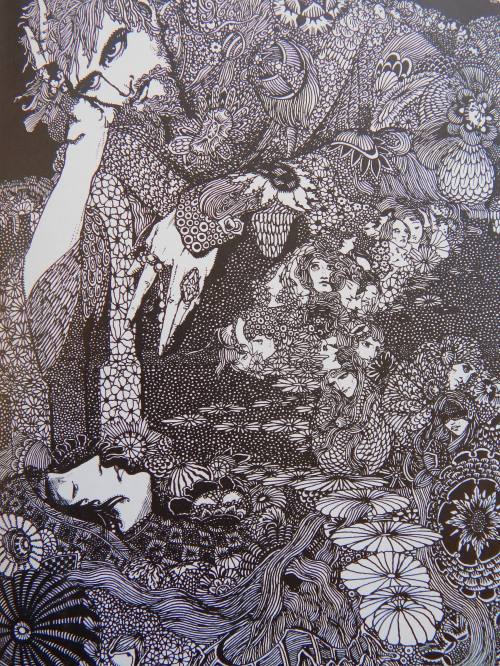
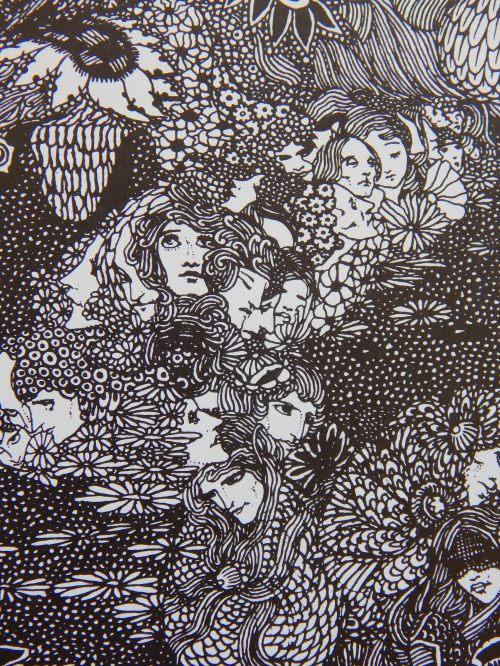
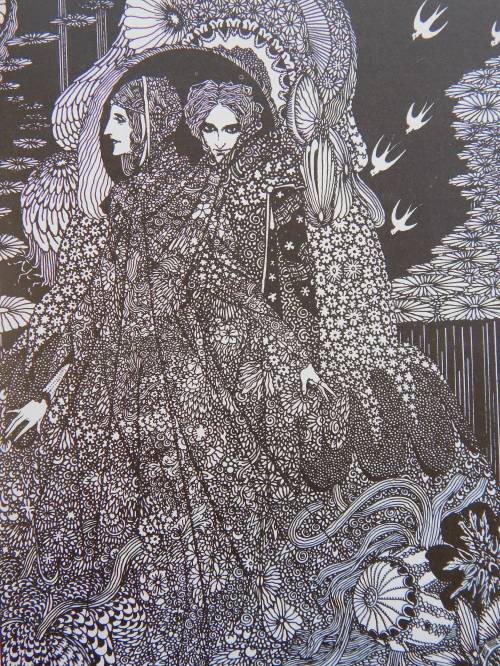
It must be a sign of the times that as I flipped through Edgar Allan Poe’s Tales of Mystery and Imagination as illustrated by Harry Clarke, I could not help but think what a great adult coloring book these illustrations would make. Perhaps not all of the illustrations … unless you’re into zombies and the Walking Dead. But these scenes from Poe’s short story Morella

and these from The Colloquy of Monos and Una called to me with their flower and nature imagery.  Harry Clarke (1889-1931) is perhaps more widely known for his stained glass work. Whether working with glass or with paper for his book illustrations, I wonder at the sources of his creative vision. I’m not always sure why I am inspired to do something but it sure is fun to take time to explore the possibilities. And to talk with other artists about their influences.

I can’t talk with Mr. Clarke but I am lucky enough to have access to a number of artists in my local community. Stay tuned for future updates about artists and their inspirations.

Read Full Post »

brazil: banknote showing freed slaves cooking

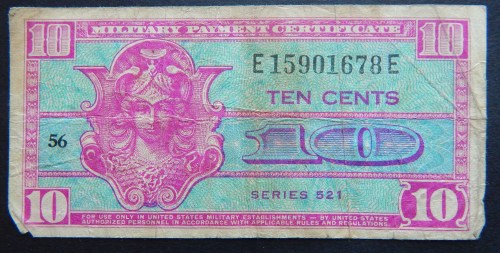
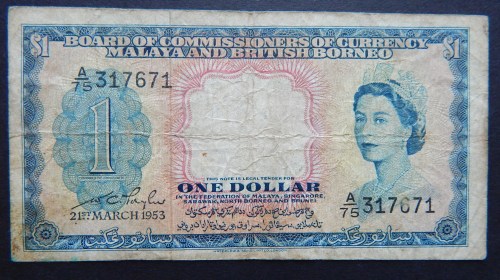
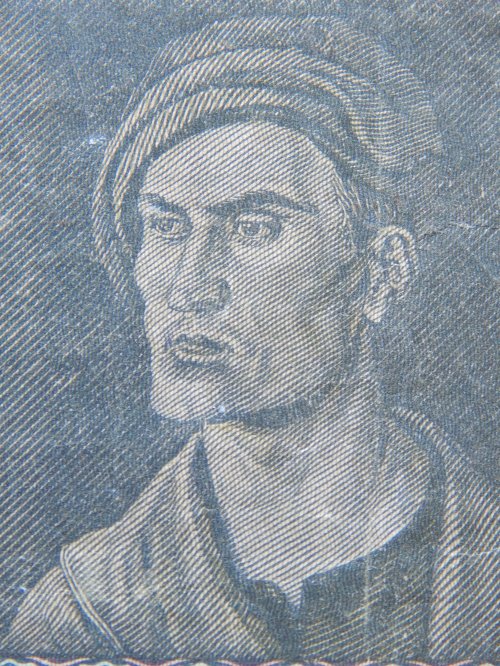
I am helping to research a bank note collection, mostly paper money from pre-World War Europe as well as other parts of the world. It is a fascinating project especially after the sometimes heated discussions here in the U.S. regarding the $20 bill and the plan to swap out the visage of Andrew Jackson for that of Harriet Tubman. Whichever $20 bill is held in hand in the future, embedded in that money, in the illustration, will be the story of that exchange. It’s the storytelling aspect that excites me about this bank note collection.  Gathered over many decades, the notes are like tiny time capsules with regard to artistic expression, economics, history and more. The nature of using money certainly continues to evolve (e.g. don’t carry cash at all, just swipe your phone!), but I expect paper money may be around for awhile.  Meanwhile, I’m looking forward to delving into the past and discovering the stories etched in these monies, a few of which are highlighted below.

    france: 1940s bank note, front image of Pyrenean shepherd

france: 1940s bank note, image of Pyrenean shepherd

germany

germany: notgeld was emergency money

british armed forces special voucher

u.s. military payment certificate

Read Full Post »
« Newer Posts - Older Posts »